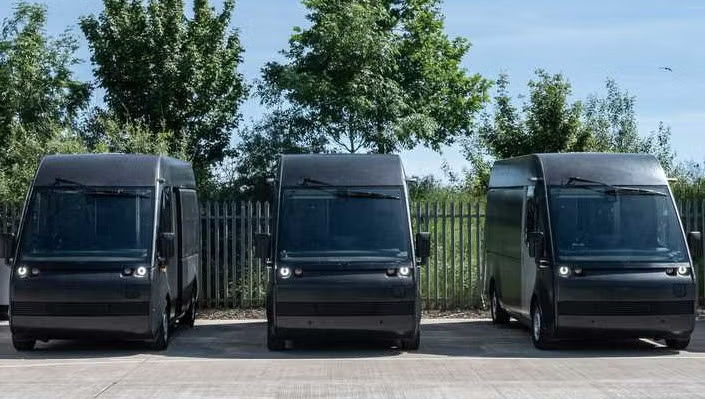
Fleet managers do not panic because one new van has a rough week. They panic when a vehicle program starts to threaten routes, driver trust, parts planning, and customer promises at the same time. The Arrival Electric Van story sits in that uncomfortable zone: less a simple tale of bad hardware, more a warning about what happens when an ambitious commercial EV plan reaches real fleet pressure before the business behind it is ready. In UPS’s official fleet electrification announcement, the company described a commitment to buy 10,000 Arrival-built electric delivery vehicles, with priority access to more, which made the program look serious to U.S. logistics readers and investors alike. commercial fleet planning insights often miss this part: a van is not a product for fleet buyers until the service network, parts flow, charging plan, software support, and production rhythm are all working together. The available public record points less to a thick stack of named U.S. defect logs and more to something buyers can learn from: how production fragility turns into fleet reliability concerns before routes even begin. Arrival’s later production delays, cash strain, and bankruptcy turned those concerns into a case study rather than a launch story.
Why Arrival Electric Van Issues Became a Fleet Planning Warning
The hard part about commercial vehicles is not the brochure. It is Monday morning. A delivery van earns its place when it starts in bad weather, charges on schedule, carries the load promised, survives careless curb strikes, and can be fixed fast when a driver brings it back with a strange noise. Arrival made a bold bet that a new vehicle design and a new factory model could bend old manufacturing rules. The tension came when fleet buyers needed old-fashioned proof.
Why production delays matter more than launch hype
A commercial buyer can forgive a prototype that arrives late to a trade event. A fleet cannot forgive missing route capacity during peak season. That is why Arrival’s missed production target in 2022 mattered. Reuters reported that the company missed its third-quarter target to start van production, with supply chain trouble named as a cause. That delay was not a small calendar slip for operators watching the project. It raised a direct question: if the builder cannot start at the planned pace, can it keep trucks moving after delivery?
The non-obvious point is that production trouble becomes a service problem before the first repair ticket is written. If a company struggles to build enough vans, it may also struggle to supply replacement doors, battery modules, sensors, interior panels, and trained field help. A broken mirror or failed latch can idle a work vehicle if the part is special and the supplier chain is thin.
For U.S. commercial EV fleets, that risk lands in the dispatch office. A van down for two days may be annoying. A van down for two weeks can force rental costs, route reshuffling, overtime, and missed service windows. That is why fleet buyers ask boring questions that matter: who stocks the parts, how fast can they ship, and who owns the repair process when software and hardware meet?
There is also a trust cost. Once a supplier misses a key production moment, every later promise gets read with suspicion. A fleet manager may still like the vehicle, but the internal meeting changes tone. Finance asks about exposure. Operations asks about backup units. Maintenance asks whether the tool budget now needs high-voltage gear for a vehicle that may arrive late or not arrive in volume.
The microfactory promise met fleet-level reality
Arrival’s microfactory idea sounded attractive because it promised lower capital needs and local production closer to demand. In theory, that model could cut waste and make smaller batches easier. For a delivery company, local build capacity also sounds like less waiting and better fit for regional work patterns.
The catch is that fleets do not buy theories. They buy uptime. A traditional van maker may be slower to change, but it often has dealer bays, field engineers, training documents, parts warehouses, and years of warranty habits. Arrival tried to build the vehicle, the process, and the support model in the same climb. That is a steep road.
One concrete example is a depot that runs 40 urban vans from 6 a.m. to 8 p.m. The fleet manager does not care if the factory method is clever when four vans need software attention before morning sort. The manager needs a fix, a clear answer, and a backup plan. That is where early commercial EV launches get judged. Not by the press photo. By the cold yard before sunrise.
The quiet lesson is that manufacturing design is part of fleet service. A factory method that reduces build cost but leaves the field team short on parts can hurt the operator. A supplier has to prove that its production system supports repairs, not only assembly. Work vehicles break in ordinary ways, and ordinary fixes need ordinary speed.
Where Commercial EV Fleets Feel a Weak Launch First
Once a new van enters service, the weak points show up in plain places. Drivers notice doors, visibility, cabin heat, step height, charging habits, rattles, warning lights, and how the van behaves with a full load. Dispatchers notice range gaps and missed return times. Maintenance teams notice whether they can diagnose faults without waiting on the manufacturer. This is where commercial EV fleets turn launch risk into daily cost, and it is where fleet reliability concerns become more than talk.
Drivers find the small faults before engineers do
Drivers are brutal testers because they repeat the same abuse all day. They climb in and out dozens of times, drag hand trucks near trim pieces, bump curbs, slam doors, idle at stops, and work in rain, heat, dust, and tight alleys. A passenger EV may spend most of its life cruising. A delivery van gets handled like a tool.
That is why small design choices matter. A weak door handle, awkward step, fragile interior panel, or poor sightline can create more complaints than a fancy battery spec can solve. A driver who does 120 stops in Columbus, Phoenix, or Queens does not want a cabin that looks clever. The driver wants a space that reduces fatigue and avoids delay.
Here is the counterintuitive part: a new electric van can fail the fleet test even if the battery and motor are fine. The “EV” system gets attention, but work vans often lose trust through ordinary body, trim, heating, cooling, latch, tire, and suspension complaints. Electric delivery vans still live in the same alleys as diesel vans. They hit the same potholes.
Driver acceptance also affects safety and retention. If the van is hard to enter, has poor storage for the scanner, or makes the driver fight the screen at every stop, the route slows. Managers may call that a training issue. Drivers call it a bad day repeated 200 times.
Depot charging exposes planning gaps fast
Charging is not fuel with a different plug. It changes the clock. A diesel van can be fueled in minutes and sent back into the rotation. A battery van asks the depot to think about dwell time, charger count, power limits, route length, weather, and whether every vehicle returns when expected. The U.S. Department of Energy’s Alternative Fuels Data Center points fleets toward planning around vehicle roles, charging, and infrastructure before adoption, which is exactly where weak launches become visible.
For a small contractor with three vans, the answer may be simple overnight Level 2 charging. For a parcel depot with 80 vehicles, the answer is a site plan. The utility may need months. The parking layout may need trenching. The software may need to stagger charging so the site does not create an expensive peak load.
A weak vehicle launch makes that harder because the fleet cannot separate vehicle problems from site problems. Did the van miss range because the route was too long, the pack was cold, the charger failed, the driver used too much heat, or the software estimated poorly? Without stable manufacturer support, the fleet team ends up doing detective work while packages still need to move.
The best depot teams build charging habits around human behavior, not only charger specs. Drivers forget to plug in. Yard movement blocks stalls. A truck comes back late and needs to leave first. These are not rare edge cases. They are normal workdays, which is why electric delivery vans need operating rules as much as they need kilowatts.
The Operator Math Behind Electric Delivery Vans
The sales pitch for electric delivery vans usually starts with lower fuel cost and less maintenance. That can be true. Electric motors have fewer moving wear items than internal combustion drivetrains, and depot charging can be cheaper than gasoline or diesel when planned well. Yet the operator’s spreadsheet has more rows than energy cost. The Arrival case showed how fragile the math becomes when uptime, resale value, warranty backing, and supplier survival enter the room.
Total cost only works when downtime stays low
A van that saves money per mile can still lose money per day. This is the first rule fleet buyers learn the hard way. If a truck misses a route, the cost is not limited to repair labor. The business may pay a driver to wait, rent a substitute, split the route, delay customer work, or lose a contract. One idle vehicle can create a chain reaction.
That is why electric fleet maintenance checklist planning needs to happen before the purchase order. The checklist should include parts access, technician training, diagnostic software, tire wear patterns, brake service rules, body repair guidance, and battery warranty steps. It should also ask who answers the phone when a fault code appears at 5:30 a.m.
A non-obvious insight here is that a lower-maintenance vehicle can demand a higher-support launch. Early EV vans may need fewer oil changes, but they often need better software help, safer high-voltage procedures, and clearer charger coordination. The maintenance burden shifts. It does not vanish.
The smarter cost model also puts a dollar value on uncertainty. If the first batch needs extra supervision, that labor belongs in the pilot budget. If only one nearby shop can work on the van, that travel time belongs in the math. Fleet reliability concerns are not feelings in this setting. They are forecast lines.
Residual value depends on company survival
Fleet buyers rarely talk about resale value with much emotion, but it shapes the deal. A van is an asset. If the manufacturer fails, that asset becomes harder to price. Used buyers worry about parts, software access, battery support, recall handling, and whether anyone can train a technician three years later. Arrival’s bankruptcy filing in Luxembourg in 2024 made this risk concrete for anyone studying the program after the fact.
For U.S. buyers, this matters because the commercial van market is practical. A used Ford, Ram, Mercedes-Benz, or Chevrolet work van has a known repair world around it. A failed startup van becomes an orphan unless another company keeps support alive. Even if the vehicle itself is interesting, the buyer has to discount the unknown.
That does not mean fleets should avoid startups. It means they should price startup risk like adults. A small pilot may be smart. A giant one-brand rollout before service proof may not. The safer move is to tie expansion to uptime data, parts performance, charger readiness, and driver feedback from the first group of vehicles.
There is another layer: insurance and body repair. A van with unique panels, uncommon glass, or limited repair procedures can become costly after a parking-lot hit. Delivery vehicles collect dents. They are not museum pieces. Any new commercial EV program has to make collision repair boring, because boring is how fleets keep working.
How U.S. Fleets Should Read the Collapse Without Overreacting
It would be easy to treat Arrival as proof that electric work vans are not ready. That would be the wrong lesson. The better lesson is sharper: commercial EV adoption needs mature execution, not louder promises. Plenty of routes are suited to battery vans, especially predictable urban work with depot parking and overnight charging. The problem is not the idea of electrification. The problem is weak proof.
Separate EV risk from startup risk
A failed EV startup can make the whole category look shaky, but those are different risks. EV risk includes range, charging, payload, cold weather, utility coordination, and battery aging. Startup risk includes funding, production maturity, parts depth, warranty survival, and service coverage. Arrival carried both, which made its fleet promise harder to trust as the company’s finances worsened.
A U.S. plumbing company in Ohio or a bakery distributor in Florida does not need to reject battery vans because a startup collapsed. It needs to ask better questions. Is the route under the van’s proven daily range with a reserve? Can the depot charge every night? Is there a service center within reach? Are replacement tires, glass, lights, and body panels easy to source?
This is where commercial EV charging planning guide content can help buyers avoid emotional decisions. The right move is not blind excitement or fear. It is measured adoption. Put vans on routes where they fit, track the numbers, and expand only when the data earns trust.
The strongest buyers also separate brand excitement from contract terms. A purchase agreement should spell out delivery timing, support duties, warranty process, parts expectations, and remedies if the supplier misses milestones. Hope is not a fleet strategy. Paperwork is not glamorous, but it saves money when the launch gets rough.
Build pilots that can survive bad news
A smart pilot is not a photo opportunity. It is a stress test. The pilot should include hot days, cold days, heavy loads, driver swaps, missed charging events, and at least one backup plan. It should also include a written support agreement that names response times, parts commitments, software access, and warranty escalation.
One unexpected detail: the best pilot route may not be the easiest route. If the first route is too gentle, the fleet learns little. A better test is a normal route with known stress, but not one that risks a major customer if something fails. That balance gives the fleet honest data without putting the business on the hook for a messy launch.
For operators, the Arrival story should raise standards, not kill ambition. Ask for proof in your climate, your depot, your route length, and your repair market. Ask what happens if the supplier changes direction. Ask whether the purchase agreement protects you if deliveries slip. The future of fleet electrification will be built by buyers who are excited enough to test and skeptical enough to protect the operation.
The best final report from a pilot is not a glowing quote. It is a plain list of what broke, what confused drivers, what charging rule failed, what part took too long, and which route saved money. That report gives leadership the confidence to expand, pause, or walk away without drama.
Conclusion
Commercial vehicles do not live on investor decks. They live on curb cuts, loading docks, rough pavement, rushed mornings, and tight customer windows. That is why the Arrival story still matters to American fleet buyers, even after the company’s collapse. The lesson of the Arrival Electric Van is not that electric delivery work is doomed. It is that a fleet vehicle has to arrive as a full operating system: van, charger plan, repair path, parts supply, software help, warranty confidence, and financial staying power. When one of those pieces is weak, the driver feels it first and the balance sheet feels it next. Fleet owners should keep testing battery vans where the routes make sense, but they should refuse to be used as unpaid proof for an unfinished program. Buy the promise only after the boring details check out. That is how electrification becomes business, not theater.
Frequently Asked Questions
What problems did fleet operators face with Arrival’s electric van program?
The biggest public concerns centered on production delays, uncertain delivery timing, service readiness, parts confidence, and the company’s financial collapse. For fleets, those issues matter because a van program must support daily routes, not only produce attractive prototypes.
Did Arrival deliver vans to UPS in the United States?
UPS announced a large commitment for Arrival-built electric delivery vehicles, but public reporting later showed Arrival struggled to reach planned production. The widely expected U.S. rollout did not become the large working fleet that early announcements suggested.
Are electric delivery vans a bad choice for commercial fleets?
No. Battery vans can work well on predictable local routes with depot parking, planned charging, and strong service support. The mistake is treating every route, climate, payload, and supplier as equal. Fit matters more than hype.
Why do startup-built work vans carry extra risk?
A startup may lack deep parts supply, repair coverage, technician training, and long-term warranty backing. Even a clever vehicle can become hard to own if the company behind it runs short of cash or changes production plans.
What should U.S. fleets check before buying electric delivery vans?
Start with route mileage, payload, charging time, depot power, driver needs, local service access, parts availability, software support, and warranty terms. A short pilot with real routes gives better answers than a sales estimate.
How does charging affect commercial EV fleet reliability?
Charging affects dispatch timing, parking layout, utility planning, and vehicle availability. If chargers fail or vehicles return late, the next day’s routes can suffer. Good charging plans include backups, load scheduling, and clear driver rules.
Is downtime more expensive for electric vans than diesel vans?
The van type matters less than support speed. Diesel vans often have wider repair networks. New electric vans may need special diagnostics and trained technicians, so downtime can cost more when parts or service help are hard to reach.
What is the main lesson from Arrival’s electric van troubles?
Treat electrification as an operating change, not a vehicle swap. A fleet should test range, charging, service, parts, driver comfort, and supplier stability before scaling. The best EV rollout is cautious at first and confident later.